Hiring AI/ML Engineers in Canada: What Companies Need to Know in 2026
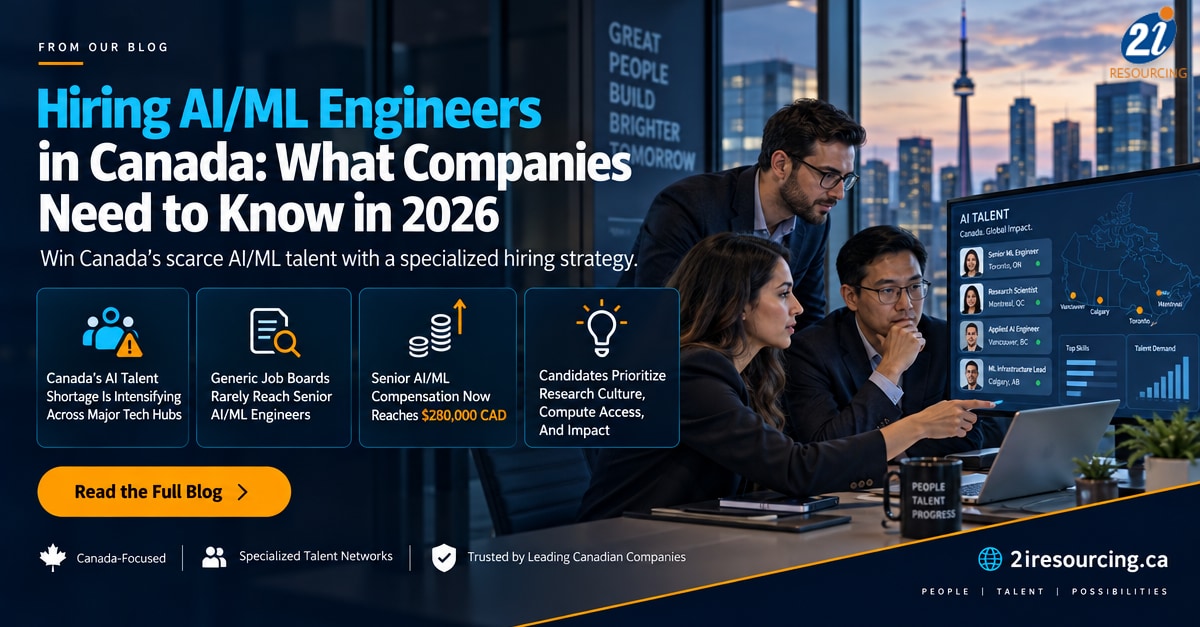
Canada produces roughly 30,000 AI-related graduates annually, according to the Vector Institute. Yet demand for qualified AI and machine learning engineers continues to outpace supply by a significant margin. Companies across Toronto, Montreal, Vancouver, and Calgary are competing for the same small pool of specialists. Technical Recruitment has become one of the most contested areas in Canadian hiring. Organizations that treat AI/ML hiring like any other tech role are consistently losing candidates to competitors who understand the market better.
Why Hiring AI/ML Engineers Is Different From Standard Tech Hiring
Hiring AI/ML engineers in Canada is fundamentally different from filling a typical software development role. These professionals require a rare combination of advanced mathematics, statistical modeling, software engineering, and domain-specific knowledge. The interview process, compensation benchmarks, and sourcing strategies all need to reflect that complexity. Companies that apply a generic hiring framework to AI/ML roles end up with mismatched candidates or extended vacancies that cost far more than a specialized search would have.
Standard job postings on general job boards rarely attract the right talent. Most senior AI/ML engineers are not actively searching. They are employed, publishing research, or building side projects. Reaching them requires a different approach entirely.
The Skill Gap Is Real and Measurable
According to a 2025 report from the Information and Communications Technology Council (ICTC), Canada faces a shortage of over 250,000 technology workers by 2026. AI and data science roles are among the hardest to fill. That number reflects both the speed of AI adoption across industries and the slower pace of formal education programs in producing job-ready graduates.
The gap is not just about volume. Many candidates who list machine learning skills on a resume have surface-level exposure, not production-grade experience. Distinguishing between the two requires technical depth in the hiring process itself.
What AI/ML Engineers Actually Expect From Employers
AI/ML engineers in Canada expect more than a competitive salary. They evaluate employers on research culture, access to compute resources, data quality, and the real-world impact of the work. A company offering a strong base salary but no GPU infrastructure or interesting data problems will lose candidates to a well-funded startup or a university research lab.
Compensation benchmarks have shifted sharply. Market trends indicate that senior AI/ML engineers in Toronto and Vancouver now command total compensation packages between $180,000 and $280,000 CAD, depending on specialization and industry. Roles in financial services, health tech, and autonomous systems tend to sit at the higher end of that range. Recent OECD analysis of AI hiring based on 12 million Canadian job postings also helps employers distinguish broad demand trends from role-specific shortages.
Remote and Hybrid Expectations
Most AI/ML engineers expect at least partial remote flexibility. Roles requiring access to proprietary datasets, specialized hardware, or regulated environments often demand more on-site presence. Companies need to be transparent about this early in the process. Candidates who discover on-site requirements late in the interview cycle will withdraw, and that wastes everyone's time.
What Candidates Are Evaluating
When an AI/ML engineer assesses a new opportunity, they typically look at:
- The quality and scale of the data they will work with
- Whether the company has a clear path from model development to production deployment
- Team composition, specifically whether they will work alongside other strong technical peers
- Publication and conference participation policies
- Equity structure and long-term upside
Companies that can speak clearly to all five of these points in the first conversation will move candidates through the pipeline faster.
How to Structure an Effective AI/ML Hiring Process
A well-structured AI/ML hiring process separates serious candidates from those who look good on paper. It combines technical depth with speed, because top candidates are typically managing multiple offers simultaneously. Companies that run slow, disorganized interview processes lose candidates before they ever reach the offer stage.
The most effective hiring processes share a common structure:
- Define the role with precision. Specify whether the position is research-oriented, applied, or production-focused. These are different jobs and attract different people.
- Screen for foundational depth early. A short take-home problem or a structured technical screen in the first round filters out candidates with surface-level skills before investing in full interview loops.
- Involve senior technical peers in the process. AI/ML engineers want to meet the people they will work with. A panel of non-technical interviewers signals a poor technical culture.
- Move quickly between stages. A two-week gap between rounds is too long in this market. Compress the process to five to seven business days from first screen to offer where possible.
- Make a clear, competitive offer. Vague compensation conversations at the offer stage kill deals. Know your range before the process starts.
Avoiding Common Hiring Mistakes
One of the most common mistakes is writing a job description that lists every possible AI/ML skill as a requirement. Candidates with deep expertise in one area, say natural language processing or computer vision, will self-select out if the posting reads like a wish list. Write for the role you actually need, not the ideal candidate who does not exist.
Another frequent error is underestimating the importance of the hiring manager's technical credibility. Senior AI/ML engineers ask hard questions. If the hiring manager cannot engage with those questions substantively, the candidate loses confidence in the opportunity.
How Technology Is Changing AI/ML Recruitment in Canada
Modern AI sourcing tools have changed how Specialized Tech Recruiters Canada rely on to find passive candidates. Platforms like HireEZ and SeekOut use AI-driven search to surface engineers based on GitHub activity, published research, conference presentations, and open-source contributions, going well beyond what a standard LinkedIn search returns. LinkedIn Recruiter itself now includes AI-powered filters that identify candidates by skill adjacency and career trajectory, not just job titles. These tools give recruiters access to a layer of the talent market that traditional job postings never reach.
That said, technology is a sourcing aid, not a replacement for human judgment. Assessing whether a candidate's research background translates to production engineering, or whether their communication style fits a cross-functional team, still requires experienced human evaluation. The best Tech Recruitment Agency Canada clients work with combines these tools with deep domain knowledge to make faster, better-informed decisions.
Data-Driven Screening
Beyond sourcing, data tools now support screening decisions. Structured scoring rubrics, calibrated technical assessments, and interview feedback aggregation reduce the subjectivity that leads to inconsistent hiring decisions. Companies that build these systems into their process make better hires and reduce time-to-fill on repeat roles.
What Good Recruitment Partners Do Differently
A generalist recruiter filling an AI/ML role is a liability, not an asset. They cannot evaluate a candidate's GitHub portfolio, assess the quality of a published paper, or ask the right follow-up questions after a technical screen. The difference between a generalist and a specialist shows up in the quality of the shortlist, not just the speed of delivery.
Effective recruitment partners in this space maintain active networks of passive candidates. They know who is open to a conversation before a role is even posted. At 2iResourcing, our AI and data science recruitment specialists maintain active networks across Toronto, Montreal, and Vancouver, giving clients access to passive candidates who are not visible on job boards. That kind of market intelligence shortens the search considerably and improves the quality of every shortlist.
What to Look for in a Recruitment Partner
When evaluating a recruitment partner for AI/ML roles, ask these questions:
- Can they name the specific technical skills required for the role without being briefed?
- Do they have existing relationships with candidates in the relevant specialization?
- Can they provide market data on compensation, availability, and competing offers?
- Have they successfully placed candidates in similar roles at comparable companies?
A recruitment partner who cannot answer these questions confidently is not the right fit for a specialized search. Software Developer Recruitment experience is a baseline, but AI/ML hiring demands a higher level of technical fluency from the recruiting team itself.
Frequently Asked Questions
Q. How long does it typically take to hire a senior AI/ML engineer in Canada?
A. Most senior AI/ML searches in Canada take between eight and sixteen weeks from role definition to accepted offer. The timeline depends on the specificity of the requirements, the competitiveness of the compensation package, and how efficiently the hiring process is structured. Compressed, well-organized processes consistently close faster.
Q. What compensation should Canadian companies budget for AI/ML engineers in 2026?
A. Market trends indicate that senior AI/ML engineers in major Canadian cities now command total compensation between $180,000 and $280,000 CAD. Highly specialized roles in areas like reinforcement learning or large language model fine-tuning can exceed that range. Equity and research time are often as important as base salary to top candidates.
Q. Is it better to hire AI/ML engineers directly or work with a recruitment agency?
A. For companies without an established technical talent network, working with a specialized agency significantly reduces time-to-fill and improves shortlist quality. 2iResourcing focuses specifically on AI, data science, and technology roles, which means the team can evaluate candidates at a technical level that most internal HR teams cannot match without support.
Q. What is the difference between an applied ML engineer and a research scientist?
A. An applied ML engineer, defined as a professional who builds and deploys machine learning models in production systems, focuses on scalability, reliability, and integration with existing software infrastructure. A research scientist focuses on developing new algorithms and advancing the state of the art, often with less emphasis on production deployment. Confusing the two in a job description leads to mismatched candidates and wasted interview cycles.
Q. How do Canadian AI/ML hiring practices compare to those in the United States?
A. Canadian companies generally offer lower base salaries than US counterparts, but the gap narrows when factoring in publicly funded healthcare, lower cost of living in most cities, and strong research ecosystems in Toronto, Montreal, and Vancouver. Many candidates actively prefer Canada for quality-of-life reasons. That said, companies competing for dual-citizen candidates or those with US offers need to close the compensation gap more aggressively.
Conclusion
Hiring AI/ML engineers in Canada is a specialized discipline. The talent pool is small, the candidates are sophisticated, and the competition is intense. Companies that treat this like a standard software hire will consistently underperform. Those that invest in understanding what these professionals actually want, build technically credible hiring processes, and work with partners who know the market will fill roles faster and retain the people they hire.
The role of a strong recruitment partner in this market is not just to find candidates. It is to provide market intelligence, calibrate expectations, and move quickly enough to compete with the other offers a top candidate is already holding. Specialized Tech Recruiters Canada organizations rely on bring exactly that combination of speed, technical knowledge, and network depth to every search.
Companies that build these capabilities, whether internally or through a trusted partner, gain a real advantage in a market where the same candidates keep appearing on every shortlist. Those that do not tend to lose the same candidates to the same competitors, repeatedly, at significant cost to their business. Working with a recruitment partner who specializes in AI and data science roles is not a shortcut. It is the most direct path to building the technical teams that matter.
Get in touch with 2iResourcing today at [email protected]